Blog Article
Restoration Company SEO Lead Generation in the Age of AI
Learn how restoration companies can use SEO, Google Business Profile, reviews, and AI-era trust signals to generate better emergency leads.
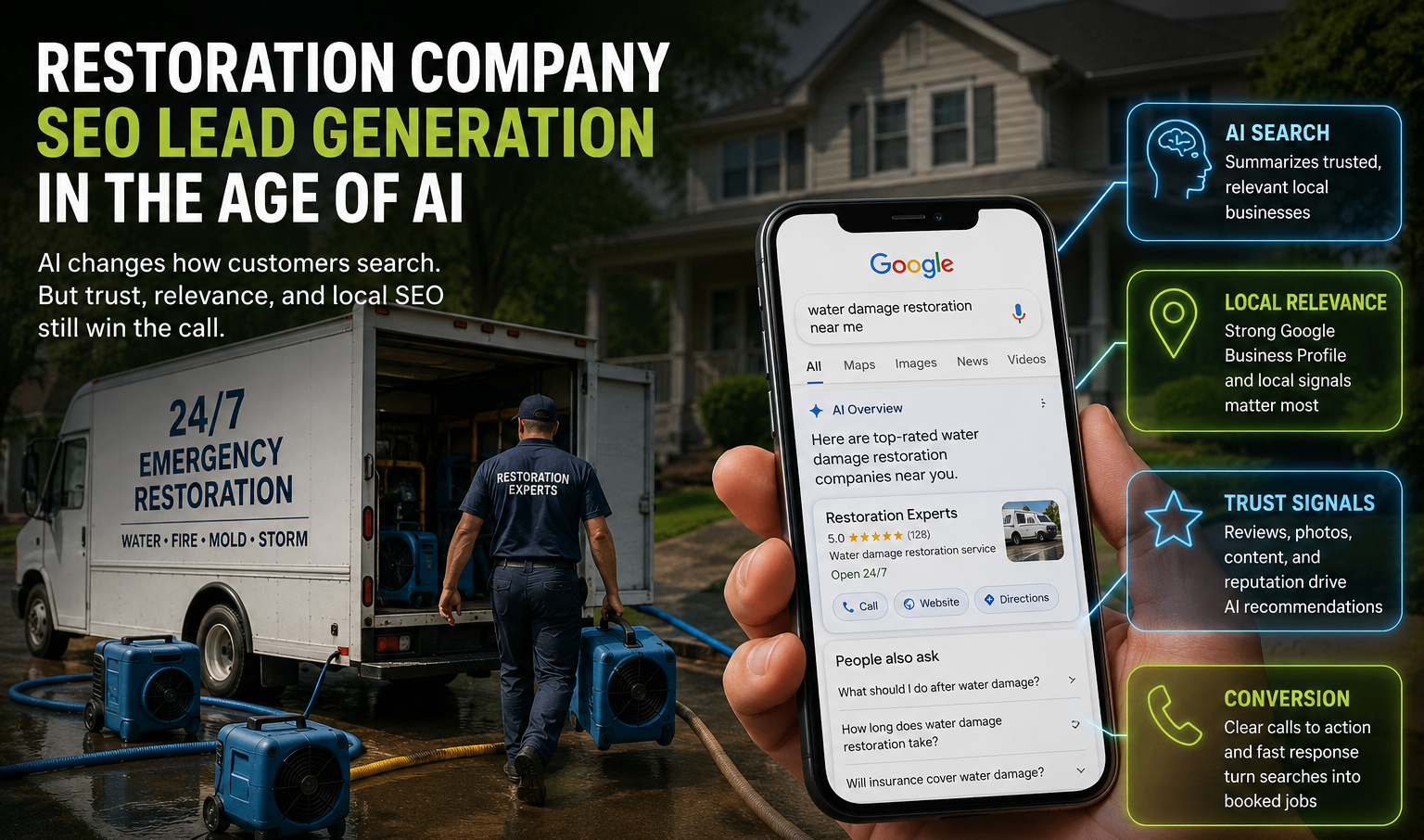
A homeowner with water spreading across the hallway is not casually browsing. A property manager dealing with sewage backup is not looking for a brand story. A business owner with smoke damage is not reading ten blog posts before calling someone.
That is way SEO lead generation for restoration companies is different from regular SEO.
For restoration and remediation companies, the goal is not just ranking for a keyword. The goal is to show up when the job is urgent, look trustworthy fast, make the next step obvious, and answer the call before the customer moves on to another company.
AI has changed how people research companies. Homeowners can compare businesses faster. Search results can summarize services, reviews, and reputation. People may ask AI tools which company looks reliable before they ever click a website.
But AI did not erase the basics. It made the basics harder to fake.
Google's own guidance for AI search says SEO best practices still apply to generative AI features like AI Overviews and AI Mode because those features are rooted in Google's core Search ranking and quality systems. For restoration companies, that means the path forward is not chasing tricks. It is building the local SEO foundation, trust signals, useful pages, reviews, and conversion paths that customers and search systems can understand.
What restoration company SEO lead generation actually means
SEO lead generation for a restoration company is not just more traffic.
It means getting found for the searches that can turn into real jobs:
- Emergency water damage restoration
- Mold remediation near me
- Fire damage cleanup company
- Sewage cleanup near me
- 24 hour restoration company
- Commercial water damage restoration
- Storm damage cleanup
It also means showing up in Google Maps, having service pages that match what the customer needs, and making the website easy to act on.
A restoration SEO strategy should answer four questions:
- Can the right customer find you?
- Can they quickly tell you handle their problem?
- Can they trust you enough to call?
- Can you track whether that call became a real job?
If the answer to any of those is no, rankings alone will not fix the problem.
Why AI changes the customer journey but not the fundamentals
AI search adds a new layer to the decision process. A homeowner may use Google, AI Overviews, Gemini, ChatGPT, review summaries, map results, and your website in the same decision journey.
That does not mean restoration companies need to panic or chase every new "AI SEO" trend.
It means your core information needs to be cleaner.
AI systems and search engines need to understand:
- What services you provide
- Where you provide them
- Whether you handle emergencies
- Whether your reviews support your claims
- Whether your pages answer real customer questions
- Whether other sources mention your business consistently
Google's AI SEO guidance is clear that traditional SEO still matters for generative AI search. Crawlable pages, helpful content, good page experience, clear structure, and content made for people are still central.
For restoration companies, AI search is not a shortcut. It is another reason to clean up the assets that should have been fixed already.
The restoration leads SEO should prioritize
Not every search has the same value.
A person searching "what to do after a pipe burst" may need guidance. A person searching "emergency water removal near me" may need a crew now.
Both searches can matter, but they need different pages and different calls to action.
Emergency intent searches include:
- water damage SEO — water damage restoration near me
- emergency water removal
- mold remediation SEO — mold remediation company near me
- fire damage restoration SEO — fire damage restoration company
- sewage cleanup near me
- 24 hour restoration company
These pages should be direct. The customer needs to know you serve their area, you handle the specific emergency, and they can call immediately.
Research intent searches include:
- how much does water damage restoration cost
- does insurance cover mold remediation
- what to do after a pipe burst
- how long does structural drying take
- can I stay in my house after sewage backup
These searches may not always become a call today, but they build trust. They also support your service pages by answering the questions customers ask before they choose a company.
The mistake is treating every page like a blog post. Emergency pages should be built to convert. Research pages should be built to educate, reassure, and guide the reader toward the right service.
Google Business Profile is still one of your biggest lead generation assets
For local restoration searches, your Google Business Profile can be just as important as your website.
Google says local results are mainly based on relevance, distance, and prominence. It also says complete and detailed business information helps Google understand and match a Business Profile to relevant searches. Reviews, positive ratings, photos, hours, and review responses can also help the profile stand out.
For a restoration company, your GBP should not look abandoned.
Review these areas first:
- Primary category
- Secondary categories
- Services
- Service areas
- Phone number
- Website link
- Hours
- Emergency availability
- Photos
- Reviews
- Review responses
- Business description
- Updates or posts
Your GBP and website should tell the same story. If your profile says you handle mold remediation, your site should have a mold remediation page. If you serve nearby cities, your site should explain that clearly. If you offer 24 hour emergency water damage response, your hours, service pages, and calls to action should support that.
Review velocity matters here
Review velocity means how consistently a business receives new reviews over time. A restoration company with fresh, steady reviews can look active, trusted, and relevant to homeowners and to Google.
That does not mean fake reviews. It does not mean incentives. It means having a real follow-up process after completed jobs.
A simple process can work:
- Ask after the job is complete and the customer is satisfied
- Send a direct review link by text or email
- Make the request personal
- Respond to every review
- Mention the service naturally in the response when it makes sense
- Keep the process consistent every month
Fresh reviews are not just an SEO asset. They are sales support for stressed customers who need reassurance.
Ranking is not enough if the website does not convert
There is no point ranking for transactional searches if the website makes people work too hard to call, book, or request help.
A restoration customer may be standing in a wet kitchen, dealing with a landlord, or trying to understand if insurance will cover the damage. Your website has to make the next step obvious.
Fix these basics before chasing more content:
- Put a clear phone number at the top of the page
- Make the phone number click-to-call on mobile
- Add an emergency CTA above the fold
- Use short forms
- Match CTAs to the service page
- Put reviews, certifications, and trust proof near CTAs
- Add insurance language where appropriate
- Use real job photos when available
- Make pages load quickly on mobile
- Explain service areas clearly
- Avoid confusing navigation
A water damage page should not feel like a generic home services page with the words changed. It should explain what the crew handles, when to call, what happens next, whether emergency service is available, and what areas are served.
The customer should never have to wonder, "Do they actually handle my situation?"
Lead follow-up is part of SEO ROI
Many SEO campaigns fail in reporting because they stop at rankings, traffic, or form fills.
That is not enough for restoration.
If ten calls come from organic search but four are missed, two are outside the service area, one is an insurance question, and only three become inspections, you need to know that.
SEO should be measured by:
- Qualified calls
- Form fills
- Calls from Google Business Profile
- Calls from organic landing pages
- Missed calls
- Speed to answer
- Booked inspections
- Closed jobs
- Cost per booked job
- Revenue from organic and map traffic
Call tracking matters because it shows which pages and channels are producing real opportunities. CRM notes matter because not all calls are equal. A 15-second wrong number is not the same as a homeowner with active water damage.
After-hours handling also matters. Restoration is not a 9 to 5 category. If the site says 24 hour emergency service but nobody answers, SEO is creating demand the business is not capturing.
That is not just an operations issue. It affects whether SEO produces revenue.
Why AI SEO hacks are the wrong focus
Restoration companies should be careful with AI SEO advice that sounds too easy.
Do not build hundreds of thin city pages. Do not stuff keywords into service pages. Do not publish generic AI content that says nothing new. Do not manufacture fake reviews. Do not create fake forum mentions. Do not treat AI search as separate from trust.
The companies that benefit from AI search will likely be the companies that already look trustworthy across Google, their website, reviews, local profiles, and third-party mentions.
That means the best AI strategy may look boring:
- Clear service pages
- Real local information
- Helpful FAQs
- Consistent GBP details
- Fresh reviews
- Strong internal links
- Crawlable pages
- Real proof
- Fast mobile experience
- Good call tracking
Boring work wins a lot of emergency searches.
A practical restoration SEO lead generation framework
Use this framework to audit your current SEO program.
1. Emergency keyword mapping Map your highest intent searches first. Separate water damage, mold, fire, storm, sewage, biohazard cleanup SEO, and commercial restoration. Then map each service to the cities and areas you actually serve.
2. Google Business Profile cleanup Make sure the profile is accurate, complete, and aligned with the website. Check categories, services, hours, photos, service areas, and review responses.
3. Service page optimization Build or improve pages for each core service. Each page should explain the problem, the service, the process, the service area, trust proof, FAQs, and the next step.
4. Local service area page strategy Create local pages only when they are useful. Do not duplicate the same page for every city. Add local details, nearby proof, specific service information, and internal links.
5. Review velocity process Ask consistently after completed jobs. Do not wait until reviews dry up. A steady pattern of real reviews helps customers see that the business is active.
6. Website conversion cleanup Improve the phone number, mobile CTA, short forms, service-specific CTAs, trust proof, page speed, and service-area clarity.
7. Call tracking and lead quality tracking Track calls by source and page. Separate missed calls, spam, wrong numbers, qualified calls, booked inspections, and closed jobs.
8. Content for emergency and research intent Build emergency service pages for urgent searches. Build helpful guides for research searches. Link research content back to relevant service pages.
9. Technical SEO and crawlability Make sure pages can be crawled, indexed, loaded quickly, and understood. Fix broken links, duplicate pages, missing titles, weak internal links, and slow mobile performance.
10. Ongoing improvement Review calls, rankings, reviews, GBP performance, and booked jobs every month. Keep improving based on what is actually producing revenue.
What to fix first
If your restoration company needs better SEO leads, start here:
- Make sure the Google Business Profile is complete and accurate
- Add or improve pages for water damage, mold, fire damage, and emergency restoration
- Add strong calls to action on mobile
- Set up call tracking
- Start a review follow-up process
- Fix thin or duplicated service area pages
- Improve internal linking between services and locations
- Add real proof, photos, FAQs, and trust signals
- Track which leads become booked jobs
- Refresh content and GBP updates consistently
Do not try to fix everything at once. Fix the assets closest to revenue first.
For most restoration companies, that means GBP, emergency service pages, mobile calls, reviews, and call tracking.
Final takeaway
AI did not replace restoration SEO. It raised the standard.
Restoration companies that want better leads need to build the local SEO foundation, trust signals, review process, and conversion path that make them easy to find and easy to choose.
That is the real opportunity. While others chase AI SEO hacks, restoration companies can improve the assets that Google, AI systems, and customers all rely on.
If your restoration company is ranking in some places but not turning search into consistent calls, Restoration Rankings can help you find the gaps.
Request a Restoration SEO Review and see what is stopping your site from turning emergency searches into booked jobs.